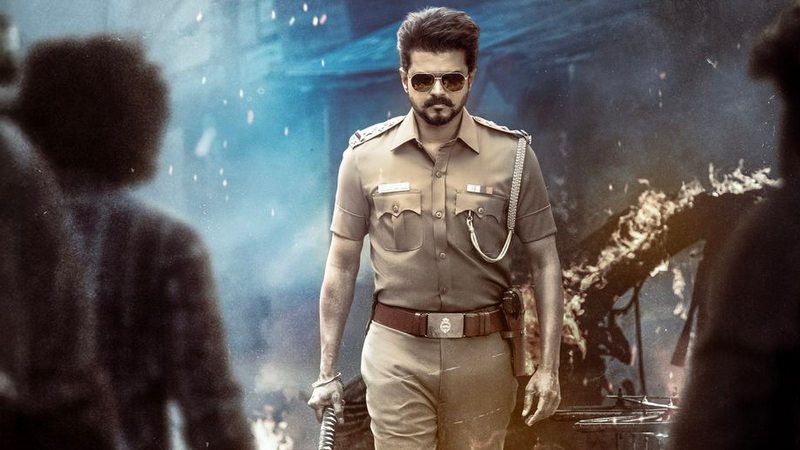
Jana Nayagan is Vijay’s much-hyped final film as a full-time actor, directed by H. Vinoth and released worldwide on July 23, 2026, after prolonged CBFC certification hurdles and delays. As a partial remake/adaptation of the Telugu film Bhagavanth Kesari, it leans heavily into mass commercial entertainment, political undertones, and star celebration, running about three hours.
The story centers on Thalapathy Vetri Kondan (Vijay), who emerges from prison after serving time and forms a protective bond with Vijji (Mamitha Baiju), the daughter of jailer Srikanth (Gautham Vasudev Menon). He commits to guiding the initially reluctant young woman toward becoming an Army officer. Parallel to this personal mission, a national threat emerges in the form of the antagonist Amrish Poojari / John Himler (Bobby Deol) and his dangerous “Project MM.” The narrative interweaves transformation, emotion, large-scale action, and confrontations over justice and security.
Vijay remains the film’s strongest asset. He slips comfortably into a larger-than-life role built around his signature screen presence, mannerisms, stylish delivery, and effortless charisma. Sequences designed for theatrical impact—the jail introduction, a high-energy interval block, an emotionally charged Madurai stretch followed by action, and the “Thalapathy Kacheri” dance number—deliver crowd-pleasing highs that celebrate his image and generate strong theater responses from fans. These moments effectively capitalize on the “one last time” farewell factor.
Mamitha Baiju gives a solid, grounded performance as Vijji and shares natural chemistry with Vijay in the guardian-protégé dynamic. Prakash Raj makes an impression in limited screen time, while Bobby Deol brings physical presence and menace to the villain role even if the character writing stays familiar. Supporting players do serviceable work within their scopes. Anirudh Ravichander’s background score effectively lifts several commercial and action set pieces (though the album as a whole is not among his peak efforts), and Sathyan Sooryan’s cinematography supports the film’s tone adequately. A few sincere emotional beats, including one addressing women’s safety, land with genuine intent and may connect with portions of the audience.
The film’s biggest limitation is its heavy reliance on the Bhagavanth Kesari template. While H. Vinoth introduces changes—primarily around the antagonist’s track, some backstory elements, and a technology-driven climax—the core structure, emotional arcs, and many narrative beats feel recycled and rewritten mainly to fit Vijay’s star persona. The result rarely feels fresh or original.
After a more engaging first half and a promising start to the second, the story loses steam. Emotional threads hold attention only briefly before the screenplay turns repetitive and uninspired. The climax suffers from predictable twists, awkward execution, and notably weak visual effects that undercut the intended impact. Logical inconsistencies (such as the ease of accessing sensitive information) require significant suspension of disbelief, and even dedicated fans may notice the stretch.
A lengthy runtime exacerbates the pacing problems; tighter editing of repetitive stretches in the latter portions would have helped. Several notable actors—including Pooja Hegde, Priyamani, Revathi, Sunil, Nassar, and others—receive limited scope and underdeveloped arcs. Bobby Deol’s mission and certain plot choices also feel dated or undercooked. Overall, Vinoth prioritizes fan-service elevations and political flavoring over a tighter, more distinctive narrative, leaving the farewell feeling more routine than memorable.
Jana Nayagan functions as a standard commercial mass entertainer powered by Vijay’s commanding presence and a handful of high-octane theatrical moments. Fans of the star will find enjoyable peaks and a sense of occasion in watching his final outing. For wider audiences, the familiar storyline, uneven second half, underwhelming climax, and missed opportunity for a stronger original send-off make it a below-par farewell that could have aimed higher. It entertains in stretches but does not leave a lasting cinematic mark.

